

Rail Transit
Pantograph
As the "energy interface" of Chongqing Light Rail, the pantograph is a key component that draws electric power from the overhead catenary, directly determining the continuity and safety of rail transit operations.
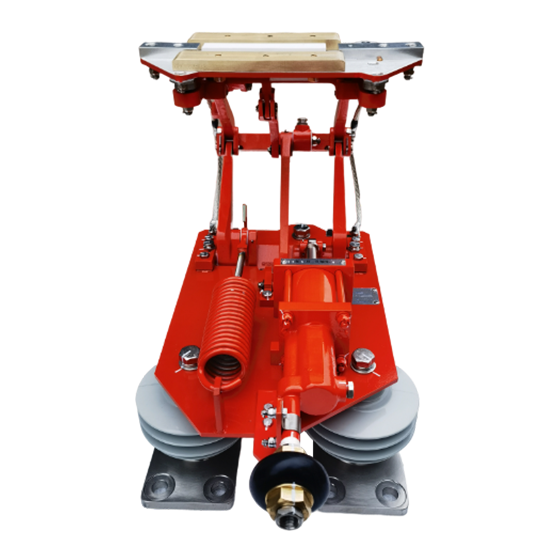
Pantographs for straddle-type monorail vehicles are divided into positive pantographs (Type DGSL-P-I) and negative pantographs (Type DGSL-N-I).
The Type DGSL-P-I positive pantograph uses springs as the power element for raising and air cylinders as the power element for lowering. The cylinder is equipped with a damping oil cylinder, ensuring stable movement during raising and lowering to avoid harmful impacts.
The Type DGSL-N-I negative pantograph features a structure basically identical to the Type DGSL-P-I positive pantograph, and also uses springs as the power element for raising.
During vehicle operation, this pantograph maintains contact with the current collector wire without performing lowering actions. Uncoupling and manual raising/lowering can be carried out when required.
Pantographs for straddle-type monorail vehicles are divided into positive pantographs (Type DGSL-P-I) and negative pantographs (Type DGSL-N-I).
The Type DGSL-P-I positive pantograph uses springs as the power element for raising and air cylinders as the power element for lowering. The cylinder is equipped with a damping oil cylinder, ensuring stable movement during raising and lowering to avoid harmful impacts.
The Type DGSL-N-I negative pantograph features a structure basically identical to the Type DGSL-P-I positive pantograph, and also uses springs as the power element for raising.
During vehicle operation, this pantograph maintains contact with the current collector wire without performing lowering actions. Uncoupling and manual raising/lowering can be carried out when required.
TECHNICAL
Technical
support
.20260408140418.jpg)
01
Serialized adaptive production support
Leveraging precision machining and modular assembly technology, we enable mass production of pantographs for various voltage levels (DC 750V/1500V and AC 25kV), suitable for a wide range of rail transit vehicles such as subways, light rail trains, and intercity trains. Customization of product specifications is also supported based on pantograph-catenary parameters, mounting interfaces, and operating speed requirements.
.20260408140429.jpg)
02
Pantograph-catenary compatibility optimization design services
The R&D team can leverage line-specific pantograph-catenary characteristics (e.g., contact wire height, wear conditions) to provide optimization of the pantograph raising curve, selection of carbon strip materials, and adaptive design of the bow head structure. They also support the integration of smart monitoring modules (wear monitoring, pressure sensing) to enhance pantograph-catenary contact stability and current collection quality.
.20260408140433.jpg)
03
Full life-cycle reliability quality control
Establish a full-chain quality control system ranging from inspection of core components (carbon strips, insulators, pneumatic systems) to dynamic performance testing of finished products, covering key indicators such as raising time, static contact pressure, insulation performance, and fatigue life, and complying with rail transit industry standards such as TB/T and EN.
.20260408140437.jpg)
04
Resolution of technical challenges under operating conditions
We can assist customers in resolving typical pain points of pantographs in actual operation, such as controlling the pantograph-catenary disconnection rate under high-speed operation, optimizing contact stability on complex track alignments (curves/gradients), improving the reliability of pneumatic systems in low-temperature/high-humidity environments, enhancing the wear uniformity of carbon strips, and extending their replacement cycles.